Or smaller dogs...
Monday, 26 April 2010
Sunday, 25 April 2010
After a drizzly Sunday
We're rewarded with a sublime sunset over the back field
The chickens have come back from foraging in the field and have put themselves to bed with full crops and the last of the day's warmth trapped in their feathers.
Thursday, 22 April 2010
Rabbits
I've been out deer stalking four nights in the last two weeks, and I've seen nothing. Well, nothing in season or nothing that I could get a safe shot at. There's some space in freezer again, so I took the soft option last night: a bit of bunny hunting.
Rabbits are not a taxing prey, as the fields are carpeted with rabbits of all ages and sizes at the moment. You could kick a stone and hit one. And it doesn't require any real fieldcraft - just warm clothes, a shotgun and good sea legs for standing in the back of a moving truck. A sense of humor helps too.
My dear old Dad gave me a new 12 bore semi-auto shotgun as a wedding present (Mike's tried not to read anything into this, though he's been on his best behavior since it arrived). It's my first semi-auto and it's taken some getting used to. It came with an extended mag so I can cram in 10 cartridges at a time.
This is the perfect back-of-the-truck rabbiting gun, when aiming becomes more of an aspiration than a likelihood. It's dark, the truck is bumping around in all directions. You see a bunny in the light and you try to follow it with the gun while trying to stay standing, and the spare tire keeps slamming into your ankles, your hip bones are banging into the metal bar that you're trying to lean against for support, and all the spilled wheat you're stood on makes it all a bit slippery underfoot. Hence, the sense of humor.
Pete the underkeeper and I did the shooting, while Mike drove and shone the light out on the fields looking for rabbits and foxes. Mike has a system for alerting us to rabbits he thinks we haven't seen: waving the light wildly and beeping the horn (what did I tell you about no fieldcraft needed?) Pete brought a rifle in case of a chance at a long-range fox, and I brought the semi-auto for bunny harvesting. As there we're no foxes and lots of bunnies, Pete and I took turns with the semi-auto. We managed 13 bunnies between us before we ran out of ammunition, about one rabbit per 3.5 shots. I don't think that's bad going when you take into account all the factors.
- Be patient. Soon the needle will start to move above the egg. If it moves back and forth in a straight line, it's a cock. If it does little circles either direction, it's a hen. If it doesn't do anything then it's infertile.
I had a half dozen bantam eggs in the pantry and under Nigel's guidance I dowsed the eggs. The needle tells me I have 3 hens, 2 cocks, and 1 infertile. I set some Silkie eggs in the incubator this morning and there was a little room left, so I put the 3 potential hen eggs in. In a few months, I will see if I have 'the touch', or if my dowsing skills are on par with my rabbit gutting skills.
Nigel took on the remains of my butchered rabbits to bait his fox traps and feed the magpies in his catchers. Have I not mentioned that it's crow and magpie trapping time? How we use a 'Judas' bird and a spring loaded trap door to catch maurading corvids? Stay tuned for the next post...
Rabbits are not a taxing prey, as the fields are carpeted with rabbits of all ages and sizes at the moment. You could kick a stone and hit one. And it doesn't require any real fieldcraft - just warm clothes, a shotgun and good sea legs for standing in the back of a moving truck. A sense of humor helps too.
My dear old Dad gave me a new 12 bore semi-auto shotgun as a wedding present (Mike's tried not to read anything into this, though he's been on his best behavior since it arrived). It's my first semi-auto and it's taken some getting used to. It came with an extended mag so I can cram in 10 cartridges at a time.
This is the perfect back-of-the-truck rabbiting gun, when aiming becomes more of an aspiration than a likelihood. It's dark, the truck is bumping around in all directions. You see a bunny in the light and you try to follow it with the gun while trying to stay standing, and the spare tire keeps slamming into your ankles, your hip bones are banging into the metal bar that you're trying to lean against for support, and all the spilled wheat you're stood on makes it all a bit slippery underfoot. Hence, the sense of humor.
Pete the underkeeper and I did the shooting, while Mike drove and shone the light out on the fields looking for rabbits and foxes. Mike has a system for alerting us to rabbits he thinks we haven't seen: waving the light wildly and beeping the horn (what did I tell you about no fieldcraft needed?) Pete brought a rifle in case of a chance at a long-range fox, and I brought the semi-auto for bunny harvesting. As there we're no foxes and lots of bunnies, Pete and I took turns with the semi-auto. We managed 13 bunnies between us before we ran out of ammunition, about one rabbit per 3.5 shots. I don't think that's bad going when you take into account all the factors.
Pete and Mike gave me a refresher lesson in gutting rabbits. I am officially rubbish at it. By the time I'd opened one rabbit, Pete had opened the other twelve.
There is a simple technique for cleaning them, which is 'The Flick': grab the head and the back feet and flick the body away from you, like you were snapping a towel. Eveything but the liver / kidneys comes out in one clean package. Neat huh? It takes a bit of practice to master.
My first flick was more of a 'flump' - everything came out but plopped on my feet. I put some oomph into the next one, but swung instead of flicked, and covered Mike all up his left side in unmentionables. Seems I'm better at the butchering than the field dressing. Thankfully, I excel at getting blood stains out of Mike's shirts.
I took off all the prime, unshot rabbit loins and thigh meat this morning while I was waiting for Nigel the hedgelayer to meet me. He's going to clear the weeds and lay what's left of the thorn hedges on the road boundary of Milkweed farm. We checked all through the overgrown hedge to make sure there were no nesting birds, as it's getting late in the season. All clear, so we'll get on with that next week. Ted the woodsman cleared the willows out of the dew pond which gives us access to extract water for the livestock.
The cleared pond
While we were looking for nests, Nigel and I got to talking chickens, as usual. Nigel told me that he dowses all his hatching eggs to find out which are the hens and which are the cocks. He kindly showed me how it's done:
- Thread a needle on a piece of cotton (thread) and tie the ends so you've got a needle hanging on the end of a 7"ish loop.
- Lay your egg on its side and touch the egg with the point of your needle. Lift the needle so it hangs just above the egg a 1/2" or so- Be patient. Soon the needle will start to move above the egg. If it moves back and forth in a straight line, it's a cock. If it does little circles either direction, it's a hen. If it doesn't do anything then it's infertile.
Nigel took on the remains of my butchered rabbits to bait his fox traps and feed the magpies in his catchers. Have I not mentioned that it's crow and magpie trapping time? How we use a 'Judas' bird and a spring loaded trap door to catch maurading corvids? Stay tuned for the next post...
Tuesday, 20 April 2010
More chicks
Another batch, hatched for a neighbor - Rhode Island Reds, Buff Orpingtons, and one lone bantam chick. They'll be moved under a broody hen tonight, the hatcher will be cleaned, and I'll set some Silkie eggs tomorrow. Our spare bedroom will be a chick nursery for a bit longer yet.
Saturday, 17 April 2010
Nature adapts
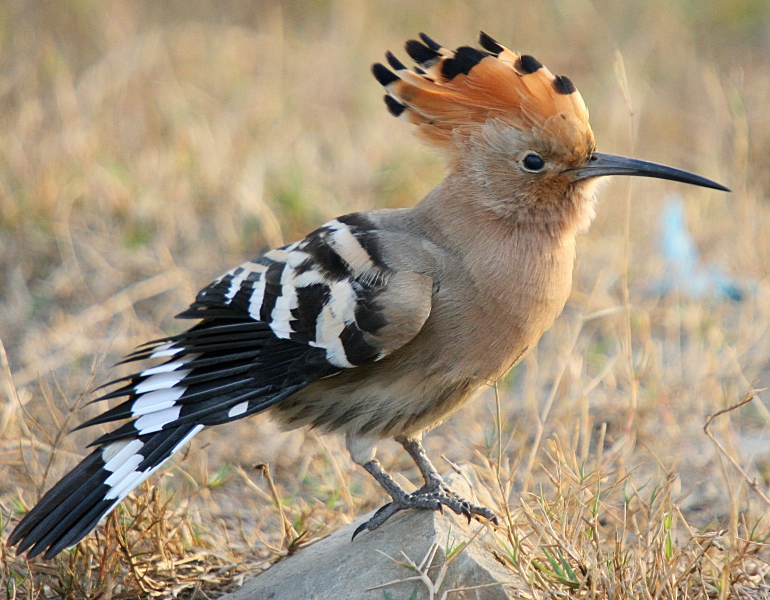
Mike went to tray pheasant eggs this morning, ready to go into the incubator, and saw a hoopoe -
See how much redder his face is too, and more engorged. That's a real ladies man - at least in the pheasant world. But when he gets worn out and tired, the other pheasant will be ready to take over and fertilise those eggs. Nature thinks of everything.
It's the weekend and even though we're on egg duty, I'm hoping we will get a chance to ride the horses tomorrow. They've been turned out on fresh grass, I've harrowed their old paddock, repaired the broken fencer, given them a trim up with the clippers, and a good grooming to remove their winter coats. They are ready for a mosey and a look around. They seem to like the view from their temporary paddock:
image from www.birding.in
I only ever saw one once, when I was living in France. They are an uncommon visitor to England. We wondered if the fallout of volcanic ash from Iceland played any part in his visit. He's been hanging around the incubator sheds all day (though not long enough for me to get a good picture!)
Our little hen continues to hatch out chicks. I should have stopped her sitting on so many eggs, or at least I should have stopped other chickens from adding to her clutch and causing a staggered hatch. With chicks and eggs she was struggling to keep both warm.
Against all advice in books, I helped a tired and cold chick out of its shell. An hour later when I checked on them, the chick was in distress and still very cold. It didn't have strength enough to move to a warmer spot under the hen. I took it away and stuck it in the warmest spot I could find - right on top of the hot water heater in the airing cupboard, tucked into a washcloth:
The little chick dried off and warmed up while we had our lunch. Once it was moving well enough, I tucked it back under its mom. I check on them every so often. So far, so good.
I had to take the rest of the unhatched eggs away, to save the five chicks. There is a setting of chicken eggs in my small incubator, due to hatch in the next couple days. Against all advice in books (again), I candled out the infertile eggs (which was about half) and put the rest in the incubator with the others. Our neighbor has a spare broody hen and offered to foster anything that comes out of the incubator. He has big Orpingtons so there's enough bottom to cover everyone.
I know I should be more hard-hearted but it's amazing what does survive when given half a chance.
The pheasant egg production is nearing maximum now. Each pheasant hen will lay about 44 eggs a year in the breeding pens, if the proper nutrition is kept up. The cock birds are doing their bit too, and it's easy to tell which ones are busiest. Here's a pheasant who's not covering many hens:
His red face patch isn't fully swollen yet. See his long tail? When they're treading lots of hens their tails get worn down and broken like this:
See how much redder his face is too, and more engorged. That's a real ladies man - at least in the pheasant world. But when he gets worn out and tired, the other pheasant will be ready to take over and fertilise those eggs. Nature thinks of everything.
It's the weekend and even though we're on egg duty, I'm hoping we will get a chance to ride the horses tomorrow. They've been turned out on fresh grass, I've harrowed their old paddock, repaired the broken fencer, given them a trim up with the clippers, and a good grooming to remove their winter coats. They are ready for a mosey and a look around. They seem to like the view from their temporary paddock:
Thursday, 15 April 2010
Just Arrived
I was beginning to wonder if this little hen was going to bring off any of her eggs. Her hopes were bigger than her bottom, but she insisted on trying to keep the whole big clutch of eggs warm. It looks like at least one egg has been successful. I'll check again in the morning. Fingers crossed, she will have added to her brood and in a few weeks' time, a string of energetic chicks will be trailing along behind their clucky hen mother sampling all the tasty bits our front garden has to offer.
Sunday, 11 April 2010
Some signs of Spring at home
Flowers are making an appearance like this Muscari -
And this Magnolia about to bloom -
Cockerels displaying their wares -
A broody hen sat tight on her clutch of eggs -
A catch crop of salad leaves starting to grow -
and seed potatoes in pots outside
Young lambs weaned on new grass and pellets-
Sleeping with the bedroom window open -
And hanging the laundry outside to dry -
Beef cattle grazing off the cover crops from shoot season -
And my highseat built and put up on Milkweed Farm -
What signs of spring are showing up where you are?
Subscribe to:
Posts (Atom)